 |  | |||
 | | | | |
Rasmus Lanken Ottesen
Birgitta Lund’s photographs depict a world disintegrated, where reality in all its forms and aspects – individual, collective, political, personal – is in continuous motion. In the depiction of her travels, the physical journey becomes a metaphor for departure on many different levels. Autobiographical elements intertwine, both thematically and visually, with the timeframe in which the photographs are taken. The traveler is in constant motion, while the pictures become fixed points from which she seeks to orient herself in a world – and a life – in transit.
The photographs depict a journey between the United States and Europe: BL leaves her home in New York to rediscover Denmark and Europe, her place of origin. Her work conveys the fundamental condition of the immigrant; with time, the idea of home becomes just as foreign as abroad.
BL begins in New York, a city far from her birthplace with a thousand different cultures. There, anonymity is the norm. Being anonymous and so far from home, psychologically and geographically, gives BL a sense of freedom. Over time the distance, initially so liberating for BL, turns on itself. It is replaced by ambivalence and a profound sense of displacement. New York is a multicultural city, and a significant factor for its residents in defining oneself is through place of origin. BL is a European, Danish woman living in New York, who, on the one hand, has too many homes, and on the other, has no home at all.
___A feeling of restlessness is at the core of the photographs. Not a restlessness that stems from a longing to be elsewhere, but one that exists somewhere in the space between departure and arrival, between a life that is disappearing in the rear-view mirror and one that has yet to begin. In this space without attachments, BL becomes a traveler, exploring both the places themselves and the movement that exists between them.
BL shoots scenes from airplanes, trains and cars – on the runway at the Copenhagen Airport, in an express train through Spain, and while passing through snow-covered forest in Denmark. Landscapes, buildings and flickering lights are frozen in the fleeting moment in which they rapidly appear and are almost as quickly gone again.
___Like the geographical locations she is passing through, the photographs themselves are fixed points in a journey, which is nomadic in its form; there is a perpetual, never-ending rhythm between departure, transit, and arrival. The dynamic of the work lies in BL’s unending desire to move both geographically and aesthetically.
___This body of work functions on many levels – narrative, psychological, formal – but is marked by several constants: displacement, restlessness, perpetual motion, and constant change. Any attempt to organize a narrative based on a beginning and end is dissolved by the departure, and continuous motion. By seeing with great sensitivity, then capturing the specifics of each place, BL builds a kind of intimacy with the viewer through the photographs, which describe the arc of her continuous journey.
___The eye is in constant motion. It records what it sees, and without dwelling too long in one place, continues, as in a photograph taken from a car while driving on a US highway outside of Washington DC. In a world dissolved by rain, the eye follows the red taillights of the car ahead; it is also drawn towards the exit, a right turn that, a sign tells us, leads toward the Pentagon and Arlington Cemetery.
Although the September 11, 2001 attack in the United States was pivotal for BL, she had considered leaving New York long before. That day, and the physical space later called “Ground Zero”, becomes the point of departure for her current journey, and a point at which a process of disintegration begins. The photographer’s reasons for wanting to leave America inevitably become intertwined with a time marked by war and terror.
___On September 11, 2001, BL is visiting Zaragoza, Spain. She is sitting in a café, when Spanish television begins to transmit live coverage from New York. The reporter is clearly agitated, and he is speaking in Spanish, a language unintelligible to BL. The network shows footage of the second plane crashing into the tower over and over again. The Spanish channel she is watching has only one camera on the scene located on a rooftop somewhere in Midtown, several miles from the World Trade Center. When half of Manhattan seems to disappear in a cloud of dust, BL has no idea if her friends are alive or if her apartment still stands. Her calls to New York don’t go through because the telephone system is overloaded.
___Shortly after the second tower collapses, Hassan, a young Moroccan, who works at the café, and with whom BL had sipped coffee, comes running in the door. Hassan waves his arms up in the air and shouts jubilantly. When his eyes meet BL, who is confused and shocked by what she sees on TV, he stops. He quickly drops his arms. A few minutes later he comes over to her table and sets a cup of coffee in front of her.
___“It’s on me”, he says.
___The next day in a different café BL asks the bartender to switch the TV to a news channel. She has no idea what has happened since the attack on New York and the Pentagon the day before. She is worried about her friends, whom she still has not been able to contact, but she is also concerned about how the United States, the wounded giant, will react to the attack. The bartender, however, refuses to turn away from the sports channel. The bicycle race Vuelta a Espana is on. None of the old men at the café want to miss today’s stage.
On the way back to New York BL photographs the metro station at Barajas Airport in Madrid not knowing that the picture will later take on a double meaning.
___In the photograph, a bird’s eye view of the illuminated city hovers above the deserted platforms and tracks leading into the darkness. This picture within the picture stands as a metaphor for the traveler’s attempt to navigate and orient herself in a world that constantly fades away into fleeting shimmers of light. At the same, time the empty train station now stands as a silent commentary on the terror that struck Madrid on March 11, 2004, exactly two and a half years after the attacks in New York and Washington D.C.
___The events of 9/11 trigger a war in Afghanistan, and later, after questionable justifications by the US government in office, another in Iraq. Spanish troops are initially part of the US-led coalition. Terrorists detonate bombs in crowded morning commuter trains in Madrid. It is because of Spain’s involvement in Iraq, the attackers announce later. On the day of the attack an exhausted Spanish policeman tells a TV crew that the worst thing he experienced was the penetrating sound of cell phones ringing in the pockets of the dead.
___In the United States, the terrorist attacks strengthen popular support for the government in office; in Spain, the government loses the election a few days after the attack.
In the aftermath of 9/11, the United States is seized with patriotism. The pressure to display one’s unwavering patriotic disposition through outside symbols reaches levels not seen in decades.
___On the telephone an Ethiopian friend of BL, who lives in a small town in the suburbs of Virginia, explains the absurdity of how American flags now hang everywhere in her neighborhood.
___Two months later the friend calls again.
___“You will not believe what we did last weekend. We went and bought a flag. In the end our house was the only one in the neighborhood without The Stars and Stripes, and we started getting nervous that it would look suspicious in the eyes of the neighbors. First we went to the nearby town, but the only flags they had left were tiny, so we drove all the way to D.C. in order to get a flag we felt was the right size,” she says laughing.
The color changes from yellow to orange on the Homeland Security Advisory System, devised by the US government to indicate the threat level of terrorism in the United States.
___BL is sitting on the Brooklyn-bound L-train. Next to her sits a woman roughly her own age. At the 3rd Avenue stop a man in his fifties BL surmises is of Arab descent gets on the train. The man and woman are acquaintances. The woman greets him with a smile and asks him how he is doing. He goes on to tell her that he has just been released from jail. This is the fourth time in six months he has been detained. He has never been charged with anything, he tells her. Nevertheless, he gets hauled in to answer numerous questions.
___“Are you connected to any particular mosque? Do you participate in any voluntary religious or political work?”
___It is the old woman living next door to the man, who is the problem. She sees him as suspicious, and therefore frequently calls the police, who then pick him up and keep him for a couple of days. He has now lost his job and cannot pay his rent.
___When the man soon after gets off the train, both the woman and BL sit back, stunned by what they have just heard.
___The USA Patriot Act, signed into law on October 26, 2001, opens the door wide for random arrests and even imprisonment without any formal charges being made. For many living in the United States, the real threat is less terrorism than the fog of suspicion in which they live simply because of their ancestry or religion.
After the war in Afghanistan the bloodshed continues in Iraq.
___The war in Iraq begins on March 20, 2003. On TV Iraqi soldiers line up to be photographed while lying in the trenches. Simultaneously US missiles hiss like furious wasps as they are launched from their pads on ships and submarines in the Persian Gulf. From the roofs of hotels in Baghdad, TV cameras scan the night sky for missiles, each time zooming in frantically when an impact creates a brief flare on the horizon.
__In New York, it rains all day. On Times Square, an antiwar demonstration has gathered a few hundred people. With signs and banners they try to make themselves heard but drown in rain, traffic noise and an all-consuming sea of light created by the square’s giant neon signs.
__The streets around the demonstration are busy as usual, crowded with pedestrians who hurry towards their destination while shielding themselves with umbrellas against the rain. In the evening the city’s windows are lit up by the diffuse, blue glow of TV screens. Lacking dramatic video CNN runs a loop showing the same explosion over and over again. An Iraqi governmental building disappears in a burning flash followed by a big fireball. It then collapses into the green darkness of night vision.
__A feeling of the surreal emerges as the images from a distant war start, increasingly, to look like fiction. The truth is in the hands of those in power, who construct their own image of war through the media. The war is only present through a stream of media images, which creates a disquieting feeling, but at the same time approaches abstraction.
BL reflects the method of depiction in her photographs. At the same time, she presents an alternative, personal approach to this abstraction.
On July 31, 2003, BL gets into a cab to go to Newark Airport. She is booked on the midnight flight to Copenhagen. The cab dives into the Holland Tunnel on the Manhattan side, and resurfaces in New Jersey. Manhattan’s amputated skyline rapidly starts to disappear in the cab’s rear window. BL has made this trip, in one direction or the other, many times; the first time was eighteen years ago when she first arrived in New York. This time she is going in the opposite direction, heading towards Denmark.
__Through an airplane window, BL sees New York fade in the horizon in the early evening light. The harbor and the industrial landscape pass beneath the airplane as last fragments of the United States.
Copenhagen is not like New York, a city of staggering heights. It is a city that, without making too much of itself, slowly embraces the traveler as she approaches the city from the airport. The waterfront dominates Copenhagen, and opens up into the sea. In the evening light ferries line the piers, illuminated and prepared for departure. In Copenhagen the possibility of the journey continuing is always present.
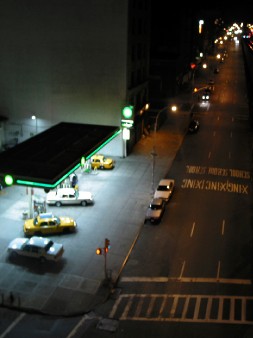
In New York, BL photographs the city from a bird’s eye perspective. In Copenhagen, she also photographs the city from above. In these images she suspends herself above the ongoing stream of impressions, and from a place of momentary stillness, traverses the mental and geographical distance between the two cities. The photographs of the cities stand as maps, with roads leading in and roads leading out; New York as a memory, Copenhagen as a territory to be studied before it can be explored.
It snows heavily, and as snowdrifts start to accumulate, the city slowly closes down. In the darkness of the afternoon light, Copenhagen is emptied of cars that crawl slowly towards the suburbs. Downtown is left behind, white and emptied of people. The silence spreads through the streets, while the snow blurs the structures of buildings, streets and parked cars, which slide into one another and lose any visible distinction.
__While the world outside slowly dissolves, the apartments turn into isolated islands. From her living room, BL watches the city stop. Still, the restlessness of her eye continues, moving out through the frost-covered windows.
Rasmus Lanken Ottesen, historian. Introduction, monograph In Transit, published by Acted Sud and Fondation HSBC pour la Photographie, Paris (2005)



 |
 |